
Golden Entertainment Inc. reported another declining quarter to end 2025, as the Las Vegas-based casino operator prepares to transition to private ownership.
The company reported fourth-quarter revenue of $155.6 million, down $8.6 million from a year earlier, and swung to a net loss of $8.5 million after reporting a profit in the same period last year. Adjusted earnings fell to $33.5 million, compared with $39.2 million at the end of 2024, according to public filings.
For the full year, Golden generated $634.9 million in revenue, down from $666.8 million in 2024. The company posted a net loss of $6 million for 2025, a sharp turnaround from its $50.7 million profit the previous year.
The results were dragged down by a $10.2 million loss from the disposal of assets, according to the company. Adjusted EBITDA for 2025 landed at $140 million, compared to $155.4 million the year before.
Despite the weaker result, Golden continued to pay its regular quarterly dividend. The company paid $0.25 per share in January and approved another $0.25 payment for April 1 to shareholders on March 18.
Golden no longer has any revenue requirements as it goes through with its previously announced plan to sell its operating assets to the company’s chairman and CEO Blake Sartini and several of its casino property holdings to VICI Properties Inc.
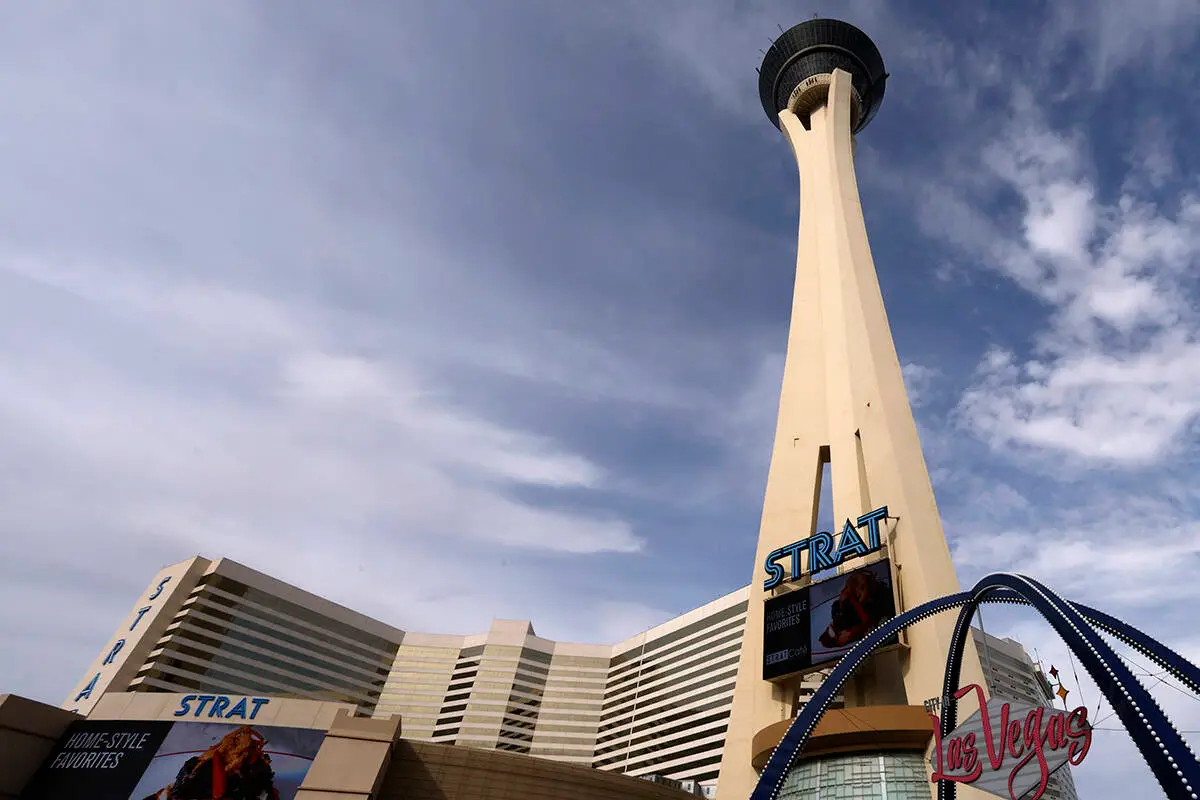
Nevada casinos changing hands as part of the deal include The Strat at the north end of Las Vegas Boulevard, the Aquarius and Edgewater resorts in Laughlin, the Pahrump Nugget and two Arizona Charlie’s casinos in Las Vegas.
When the transaction closes, Golden’s stock will be delisted and the company will operate privately.
The company ended the year with $438.7 million in total debt, mostly from a $390 million loan, and reported $55.3 million in cash. Golden also had $195 million available on its revolving line of credit as of Dec. 31, a figure that increased to $203 million after an $8 million repayment made in late January.
MGM Resorts, BetMGM donates $1 million to problem gambling
Las Vegas-based MGM Resorts International and its digital gaming partner BetMGM announced an expanded $1 million commitment to responsible gaming.
The two companies joined the National Council on Gambling in marking March as Problem Gambling Awareness Month. The funding will support research, public education, community partnerships and employee training, according to a press release.
The companies committed $450,000 to the International Center for Responsible Gaming to support a new research initiative focused on sports gambling behaviors, risk factors and emerging trends. MGM Resorts and BetMGM will also direct more than $850,000 in 2026 to state and national organizations involved in the prevention and treatment of problem gambling, while expanding its GameSense program across casino floors, sports books, digital platforms and employee training.
MGM Resorts will launch a new “Earn More. Play Smart.” campaign this spring to integrate responsible gambling messaging into its MGM Rewards loyalty program, while BetMGM continues to promote its hockey-themed responsible gambling ads featuring NHL superstar Connor McDavid.
Additional initiatives include experiential training offered through EPIC Global Solutions and continued participation in industry-wide responsible gaming campaigns such as the American Gaming Association’s Have A Game Plan program.
Macau February results
February gaming revenue in Macau was lower than expected, but better than feared, a New York analyst said.
The Gaming Inspection and Coordination Bureau of Macao on Sunday reported gaming revenue of $2.56 billion (US), an increase of 4.5 percent compared to February 2025.
A large part of the increase was due to the Chinese Lunar New Year falling in February this year, compared to January last year.
“While this was weaker than the market and our initial estimate, it was better than the trend of our weekly channel controls, which had indicated a year-over-year decline in the first three weeks of February,” Jefferies Equity Research analyst Anne Ling said in a Monday report to investors.
In the first two months of 2026, gaming revenue in Macau has soared 13.9 percent to $5.63 billion (US).
“The acceleration towards the end of the month and the Chinese New Year is encouraging and should be a modest positive for the related stocks,” Ling said in his report. “It is clear that measuring expectations remains challenging as the market evolves post-COVID-19 with respect to non-gaming investments, new or relocated assets and management changes.”
Insider trading
The Commodity Futures Trading Commission has announced a pair of disciplinary actions involving insider trading by clients using the KalshiEx prediction market exchange.
The CFTC last week confirmed disciplinary action against Kyle Langford, a candidate for a US House seat in California, and Artem Kaptur, an editor for the MrBeast YouTube channel.
Kalshi accepts prediction contracts on current events, including election results. Prediction markets are under scrutiny in Nevada because state gambling regulators say Kalshi is illegally taking sports bets on the outcome of games without being licensed.
The actions against Kaptur and Langford are the first major disciplinary actions taken by the CFTC, a federal agency that oversees fast-growing prediction markets.
Kalshi policed himself on both issues.
According to the CFTC, social media posts in May contained videos that appeared to show a political candidate trading his own candidacy on Kalshi. Kalshi’s compliance team contacted the candidate the same day, and the trader admitted that he knew the trades were inappropriate and violated Kalshi’s rules, which prohibit trading in a contract over which the trader has direct or indirect influence over the outcome. Kalshi imposed a financial penalty of $2,246.36 (suspension of $246.36 related to the improper trading activity, plus a penalty of $2,000) and a five-year suspension from direct or indirect access to the exchange.
Langford is listed as a candidate in a nonpartisan primary race for a U.S. House seat in California’s 26th district.
According to the CTFC, in August and September, an individual traded a prediction market related to a YouTube channel while having an employment relationship or other formal connection with the subject of the contract, through which the trader likely had access to material non-public information related to his trades, in violation of exchange rules. After investigating the highly successful trades and the trader responsible, Kalshi discovered that the trader was an editor for a YouTube channel who likely had advanced knowledge of the content of the channel’s videos before they were publicly posted. Kalshi concluded that there were reasonable assumptions that the trades were based on material non-public information misappropriated in violation of a pre-existing duty and imposed a financial penalty of $20,397.58 (disgorgement of $5,397.58 in profits from the illegal trade, plus a $15,000 direct disqualification from two or two years to direct access).
Gaming regulators in Nevada allege that Kalshi operates its sports prediction markets with little regulatory scrutiny.