
Will artificial intelligence put me out of a job?
That’s the lingering fear some gaming industry employees are considering as rapidly evolving technology is used in workplaces around the world, including in casino environments.
On the surface, the use of data, algorithms and computing power that simulate cognitive functions that allow machines to act like humans has been seen as a good thing. AI can minimize repetitive work for mathematical calculations and can make accurate predictions about whether a player is showing signs of compulsive behavior while playing.
AI has become a part of gaming and industry leaders have begun to debate whether and how to handle it.
UNLV in May launched the Artificial Intelligence Research Hub (AiRHub) to address questions involving the pros and cons of AI in gaming, and researchers expect to deliver papers later this year on whether regulatory safeguards should be implemented to prevent harm to consumers who gamble at the state’s casinos and employees who work there.
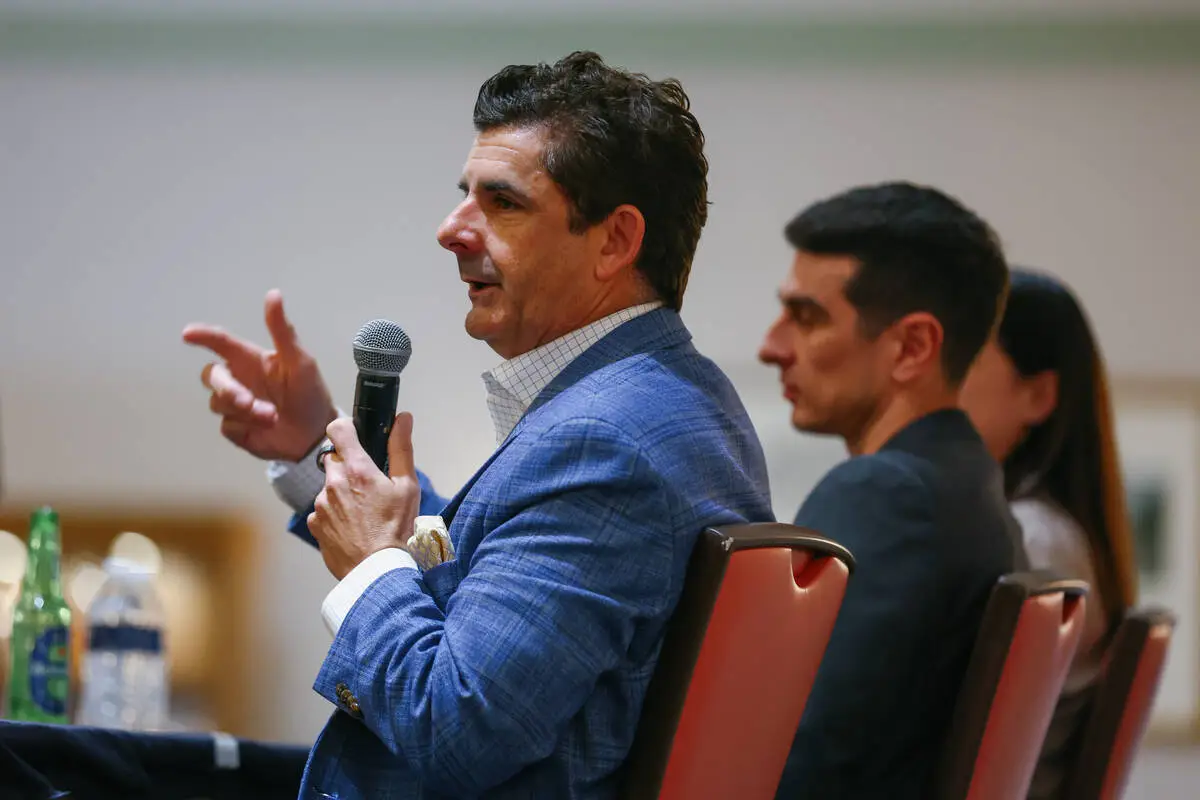
“We basically launched this initiative because we saw a small gap,” Brett Abarbanel, executive director of UNLV’s International Gaming Institute, said in a panel discussion last month on AI’s impact on Las Vegas’ gaming economy, presented by the Economic Club of Las Vegas at Park MGM.
Deep into AI
“There wasn’t any kind of academic institution or anybody really doing a deep dive into what AI means in the corporate sector,” Abarbanel said. “So the Gaming Institute has always had a reputation for doing independent research and providing data-driven insights for the industry throughout its 35-year history. So what better to do with the advent of this transformative technology that is AI than to set up an initiative to provide that leadership to the industry in terms of what it means for the sector?”
Abarbanel was joined on the panel by Kasra Ghaharian, director of research at the institute and co-author of previous reports on AI in gaming, and Rick Arpin, managing partner, Las Vegas at KPMG, a multinational professional services firm specializing in accounting.
Ghaharian and Fatemeh Binesh, a professor in the University of Florida’s Department of Tourism, Hospitality and Event Management, wrote in a 2025 report that AI is being used in marketing, security and to detect gambling addiction of players.
“While AI customization in the casino industry is still evolving, it has been used in various aspects,” the report says. “For example, online gaming platforms are using AI-powered analytics to create highly personalized marketing strategies, offering promotions and bonuses tailored to individual players’ habits and preferences,” the report said.
“Casino game developers are using AI to create more interactive games, and potentially the use of virtual and augmented reality in this area. And slot machine manufacturers are leveraging AI-based facial recognition technology to strengthen security and compliance and improve the customer experience when logging into loyalty programs.”
But the authors also said it’s not positive, and the industry is still learning to use AI and meet emerging challenges.
“Despite its potential, the introduction of AI in casinos faces challenges, such as resistance to change, infrastructure limitations and legal challenges,” the report said.
“The digitization of the gaming product has evolved both the player experience and the operations of the business. Slot machines now include a wide variety of designs with engaging visual displays, with back-end software that enables the collection of detailed bet-by-bet information. The Internet has made it possible for consumers to have access to gambling on demand, and online operators can easily track the behaviors of these players, including how often and which games they play.
AI and responsible gaming
“AI can improve responsible gambling by detecting problematic behaviors early and offering personalized interventions,” the report said. “AI algorithms can analyze player data to identify patterns indicative of gambling addiction to enable rapid support. This has led to the creation of strategies that seek to prevent gambling-related harm, including the implementation of responsible gambling tools such as limit setting, mandatory play breaks, cooling-off periods, pop-up notifications, personal messaging programs and self-exclusion.”
But what is worrying is that offshore casino operations can instead exploit a compulsive gambler instead of helping.
The panelists attending the Economic Club event said AI could also be used as a tool to monitor and protect the integrity of sports by identifying potential spot-shaving and game-fixing scandals well before sportsbook operators could detect them. Abarbanel indicated that discovery of match-fixing scandals can sometimes lead to even bigger criminal violations.
“You may have noticed a lot of headlines recently in terms of scandals, some even as recently as last week and the other day surrounding the NCAA,” Abarbanel said in the panel discussion. “You may have noticed the huge scandal surrounding possible mob-run poker games associated with various NFL players, various MLB players who have been suspended for being found to be playing. All of these things play into this larger realm of what sports integrity is and can mean, whether it’s fixing an entire game, whether it’s doing something like shaving, just a single point where you can fix it in a single point where you can just fix it. to something in a bill investment.”
The panelists also discussed concerns some casino workers have that they could lose their jobs if certain AI applications could reduce the workforce.
In most work sectors, the use of AI technology increases productivity and reduces repetitive work. These pluses are why some casino IT departments are enthusiastic about implementing the use of AI in their employees.
Can AI reduce jobs?
Still, there are lingering concerns that implementing AI will put some people out of their jobs.
The panelists agreed that most jobs are safe because live entertainment, including casino gaming, is a social activity that will be difficult for a machine to replicate.
Arpin is confident that human interaction will continue to thrive in casinos because that’s why people enjoy them.
“The reason I go back to it is because this has been studied pretty extensively and so there’s a reason live entertainment has flourished regardless of some of the trends of the last 20 or 30 years,” Arpin said. “There’s a reason why sports is one of the last live television experiences that’s in demand. There’s a reason that whether it’s Las Vegas or other casinos or other tourist destinations will continue to thrive. It’s because people like to come together and people like the interpersonal experience.”
The need for human interaction was amplified by the covid-19 pandemic. While many are enjoying the freedom of working from home, many companies have reopened their workplaces to allow employees to interact.
“I know some of you have teenagers who use their headphones and devices all day, and some of you have 25-year-olds working for you who grew up in a texting generation,” Arpin said. “But some of these 25-year-olds are now 30-year-olds who say, ‘Gee, that covid thing was really boring. I want to be back in the office and with people and I want to learn from interpersonal experience. And last time I checked, other than during covid when we literally couldn’t go to a resort, we’re still here.”
Arpin believes that like all the other times Las Vegas has been threatened by potential market changes — like when gambling was legalized in New Jersey, when riverboat casinos were first introduced, when tribal casinos sprung up across the country — Las Vegas reinvented itself to meet the challenges. He is also convinced that last year’s decline in tourism is the result of other factors and not AI.
“You can gather at a resort that has a 50-person stadium roulette game instead of individual roulette tables because it’s more efficient and still provides a great experience and the casinos love it and the customers love it,” Arpin said. “So do you need a few less dealers? Yeah, but you still need dealers, you still need people on the floor and people bringing drinks and all that. Is getting a drink from a robot as much fun as getting it from a person? As far as I can tell, no, and not for the foreseeable future.
“I will say it might change, but just as people want to congregate, people want interpersonal experiences. And so Las Vegas, just as it has reinvented itself dozens of times over the last 80 years, will reinvent itself as needed to address that.”
–