
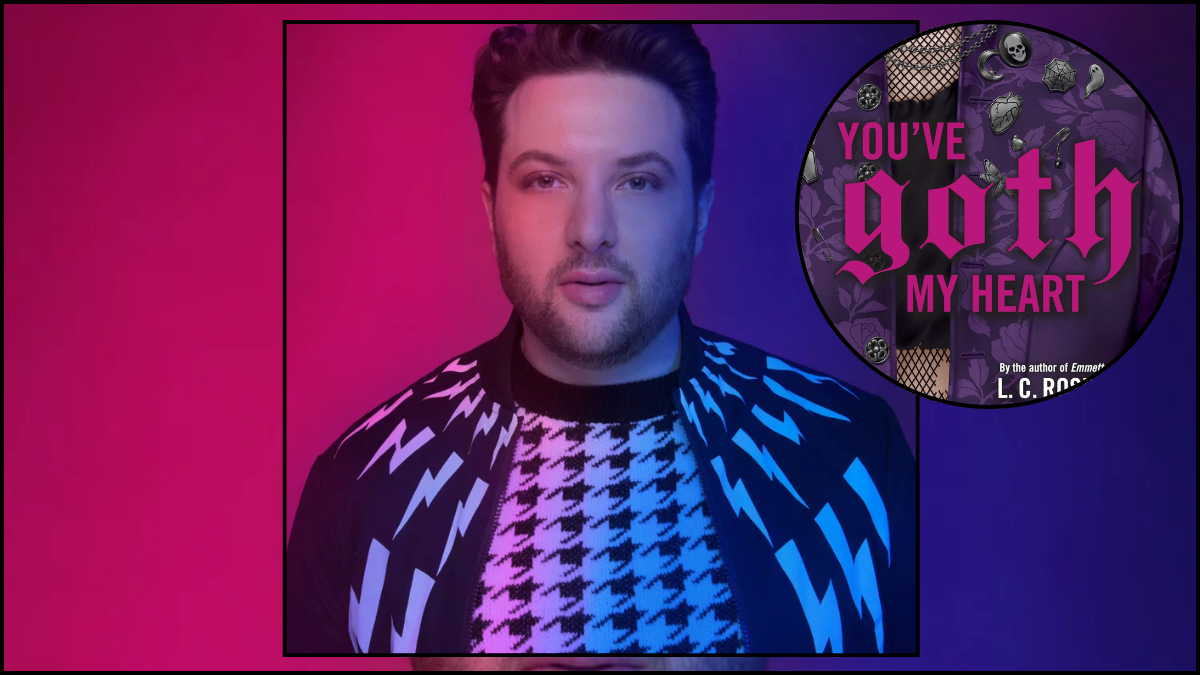
“What’s romance without a little risk?” LC Rosen teased out in his characteristically witty way—a question that feels as much a challenge to his readers as it does a mission statement for his latest YA novel, You have my heart (out since September 9). Known for his acclaimed works such as Camp and EmmettRosen returns this terrifying season with a darkly funny, eerily romantic tale that blends mistaken identity, digital intimacy and gothic aesthetics into a love story that’s as terrifying as it is heartfelt. In true Rosen fashion, it’s a story that balances fear and joy, proving that falling in love—especially as a queer teenager—is both exciting and terrifying.
Set against the small-town chaos of Sleepy Hollow’s Halloween celebration, You have my heart introduces readers to Gray, a self-conscious and troubled teenager whose summer takes an exciting turn after a wrong-number text opens the door to romance, mystery, and danger. With a closeted ex in the background, a new goth competitor for attention, and whispers of a serial killer stalking local gay teens, Gray’s journey is equal parts suspense and swoon-worthy romance. Through laughs, chills and heartfelt moments, LC Rosen delivers a story that captures the queer teenage experience with humor, nuance and authenticity.
At ThePlayerLounge, I had the chance to sit down with Lev Rosen and dive into the inspirations behind it You have my heart— from the romance of accidental connection at its core, to the playful yet haunting Halloween backdrop and the modern angst and thrill of digital intimacy. We also explored his ways of breaking stereotypes in queer literature, navigating the publishing world, and giving teenage readers characters that feel real, messy, and totally lovable.
Read on as Rosen opens up about storytelling, love and the risks that make both unforgettable.

“You’ve Goth My Heart” mixes goth culture, mistaken identity and queer romance with both humor and suspense. I’m curious – what was the initial spark for the story? Was it the title, the tone, or a character you just couldn’t shake?
Hello! It started as a joke, honestly. The original title was You have Goth Mail. I’d known I wanted to do a pagan book—and maybe a goth book—for ages, but I had no idea what it would be until I made that joke, and then a whole concept flooded into my brain.
Were there particular films, stories, or cultural influences that shaped this novel? How did you reimagine them to create something relevant to today’s YA readers?
Well, obviously, You have Mail was a major influence – like all its predecessors, back to the original Hungarian play Perfumeryand adaptations that The shop around the corner. My favorite though is the musical She loves mewhich I used as a model for this one – taking the supporting characters and the general vibe and making it modern and queer.
It honestly wasn’t that hard; people today talk on social media all the time, and in the apps it’s often anonymous – or at least we all know that someone could be catfishing us at any moment. People still fall in love. I love that about people – how even when they’re super skeptical, they can still fall in love. It’s timeless, but the internet part of it is still pretty new.
Speaking of modern twists, Gray’s story begins with a wrong number text that captures modern intimacy. What made you explore that premise, and how did you ensure that the on-screen romance felt emotionally grounded and believable?
I knew that for the story to work we had to open with them falling in love, so the opening part is entirely their texts over the summer. It was, I think, a big gamble. But I needed to show this very specific type of relationship – and while many of us are familiar with what that might feel like, it still needed a lot of grounding to make the rest of the book work. I was also really lucky that my publisher was open to the idea of a visual kind of framing of the lyrics – art on the page that really makes it clear that this is texting, separate from real life. A virtual honeymoon phase.
As for why I wanted to explore it – well, as I said, the idea came first. But we all talk like this now. We text and, as I said, we fall in love with strangers. Isn’t that fun? Isn’t that also insanely dangerous?
And that brings us to Gray himself – he’s self-aware, troubled, funny and quietly brave. How did you find his voice, and were there aspects of his insecurities or idiosyncrasies that resonated with you personally?
In my rom-coms (and an anti-rom, still-com) I try to play with the queer male stereotypes that somehow got me in my youth. Jack is a sleazy femme punk type, Randy is an annoying theater kid, and Emmett is a condescending prep. But Gray is the stereotype I actually was – the angry goth (although I was also deeply condescending). It’s always fun and hard to take these less likable archetypes and make them feel worthy of love, but Gray was a struggle because he’s so defensive, angry, and kind of lost.
It also felt true to what I know teenagers today have to deal with – the pandemic, climate change [and] war. I feel quite lost and angry myself. But as a teenager? Are you trying to imagine their future today? It will make you angry. So much of it came from that.

Shifting slightly to the tone of the book, “You’ve Goth My Heart” manages to be spooky, funny, suspenseful and romantic all at once. How did you balance these tonal shifts while maintaining the emotional core? What guided your approach to creating such a vivid, goth-meets-small-town Halloween world?
I have my editor to thank for much of the tonal balance. There were versions that were much darker – possibly too dark for a book that is ostensibly a romance with a happy ending. The serial killer plotline has changed a lot. But I tried to bring in this sense of dark humor that really connected things, and this belief that even though the world can be horrible sometimes, that doesn’t mean you can’t find beauty in it. That’s what I was always aiming for: the beauty.
Your work often mixes humor, heart, and darker themes while centering queer adolescence. How do you approach depicting these emotional stakes in a way that feels both honest and accessible to YA readers?
It’s about remembering that your characters are real people, which gives them a lot of depth and contradictions. I think a lot about Walt Whitman—this idea that each of us is a universe. We have all of these things in us—humor, heart, darkness—and as a teenager, they’re even closer to the surface. Just remember that, and everything else will fall into place.
Were there particular scenes or characters in You’ve Goth My Heart that you enjoyed writing – or moments that challenged you creatively? How did you navigate these challenges?
I had so much fun figuring out the Halloween houses and the whole Halloween Graveyard Fair. I’ve been to events like that, but being able to create my own—with no budget constraints—was a lot of fun. As far as challenges go, I think writing the trapped ex plotline was difficult. It was rough, and I hope very honest. But again, to get through that I just tried to keep the humanity of my characters in mind and let them be angry at each other, or give each other grace, at different moments.
Authentic queer representation has always been a cornerstone of your storytelling. How has your approach to YA evolved over your career, especially in today’s expanding but still scrutinized publishing landscape?
Well, like I said, I’ve tried to embrace these different stereotypes in my comedies. Then I have my YA adventures, which Tennessee Russo comics, which are also very queer. I think I’ve just approached each book as its own thing, not in relation to the book world. Doing so, I believe, only leads to disappointment and missed points. I focus on my characters and what I want the book to be. People will review as much as they want, no matter what. Write the book for you – or for the younger you, as I do with these.
Looking at your work pace, 2025 alone saw three very different editions. How do you juggle such different worlds while keeping each story distinct? And when you step away from writing, how do you relax and recharge?
Well, it is important to note that the publishing business is slow. Books, even when finished, are still at least a year away from publication, and sometimes they are delayed by external forces, as happened with one of these. So it’s not like I wrote all of these in one year, or that I didn’t write any of them this year – while they come out fast and hard, they weren’t written that way.
With all my books, I start writing them by absorbing outside media: watching movies that have the feel I want, listening to playlists, going to art shows or galleries, and consulting research, fiction, or art books that inspire me and get me into the headspace of the story I want to tell.
As for unwinding and recharging – I’ll let you know when I’ve accomplished that.
Thinking about the big picture, what trends or themes in YA fiction are you most excited about right now? Where do you hope queer literature will develop next, and are there particular stories you wish more writers would tackle?
I would love to see more historical queer YA. I see a few, and it’s all excellent, but really well-researched, non-speculative queer YA feels like something a lot of publishers don’t take a chance on. I also feel that queer YA needs to engage a little more with queerness itself. We used to have all these coming-of-age stories—it felt like the only story we were allowed for a while—and now we have all these romances. And there are a lot of people out there who say things like “It’s a rom-com where the characters happen to be gay.” I can’t express how much I hate that “happened” in that context.
Especially today, the idea that engaging with your queerness—or how the world views your queerness—is somehow bad, or makes you someone whose “being gay is their whole personality,” is something I find insanely wrong. The act of falling in love as a queer person in a world where people actively don’t want you to is an inherently political act, and shying away from it won’t make it any less political or protect you from those people.
On the other hand, I also realize that maybe we need aspirational worlds where it really doesn’t matter – comfort stories to keep us going – and I don’t begrudge anyone that. I just think publishers see queerness, especially in YA, as that comfort story and are afraid to actually engage with queerness. It bothers me. And I still won’t read anything where the marketing material says someone “happens to be gay.” But that’s my personal thing; I know. I’ve seen that phrase too much as an insult to other stories – I can’t remove it.
Finally, if Gray could send one last text to his mysterious stranger—something that captures what he’s learned about love and fear—what might it say?
“Hope is goth.”
Pick up your copy You have my heart today!
Did this behind-the-scenes look at “You’ve Goth My Heart” pique your curiosity? Join the conversation on (@ ThePlayerLounge), and check out more exclusive author interviews on ThePlayerLounge.